Vol. 2 No. 1
March 22, 2012


SEARCHING FOR LIVING RELATIVES
Carolyn Dyess BalesWe all know we search for deceased people for our genealogy. However, tracing our family tree forward is a great way to enhance our genealogy experience. Sometimes “reverse genealogy” will give us new resources and allow us to connect with family members we never knew we had. From experience I have connected with living relatives who have shared their family stories, pictures, and trees. How do we make these connections? I’m sure there are many more ways than I have listed and would love to hear from you about your additional resources and experiences. Lets start with the Social Media. 1. Facebook.com – With almost a billion users, you have this resource to locate living relatives. I have a Dyess (all spellings) page on facebook with over 600 members. I would never have found a lot of information about the Dyess family without this resource. It has enabled me to get ancestors’ pictures and stories that are priceless! I also have a Bonnette (all spellings) Facebook Page. 2. MySpace.com – I have not been as successful with mySpace locating as many relatives as I have with Facebook. However, I have connected to a few relatives there also. 3. Google+ Circles – This social network is like a genealogy conference. It is designed for forced sharing with people who have common interests. I have not been as successful with meeting new relatives there – but – I have been very successful getting general genealogy information from this source. They do have a chat feature – but Facebook is getting that too. Google+ Circles has the Group Chat that has been pretty successful. 4. Linkedin.com – It is a business networking Site. I have connected with relatives and the business genealogy world here. 5. Twitter.com – This is, yet, another social networking tool with which I have had some success. The best way for me to distinguish between Twitter and the other social media – is to me Twitter is more like texting on a phone. You post a sentence and/or a few sentences to express an opinion or ask a question. Other ways to locate living people are: Newspapers – Articles, wedding announcements, obits, etc, lists living people. A subscription site –GenealogyBank.Com – offers more than 5,800 historical newspapers, as well as a collection of modern obituaries from 1977 to present. For links to collections by state, online Historical Newspapers(sites.google.com/site/onlinenewspapersite) listings give the county and time period covered. Family Tree Data Bases – While a lot of living information is not placed in the trees, you can always contact the owner of the tree and share information about living people. Contacting the owner of the tree containing your ancestors can pay off. Here is a list of some of the available online trees: *
- ancestry.com/search/rectype/trees/publictress.aspx *
- MyHeritage – www.myheritage.com *
- WikiTree – www.wikitree.com *
- AppleTree – www.appletree.com *
- FamilyPursuit – www.familypursuit.com *
- FindMyPast – www.findmypast.com.uk *
- GenCircles – www.gencircles.com *
- GeneaNew – www.geneanet.org *
- Genebase – www.genebase.com *
- GenesReunited – www.genesreunited.com *
- Geni – www.geni.com *
- OneGreatFamily – www.onegreatfamily.com *
- OurFamily*ology – www.family-genealogy.com *
- TribalPages – tribalpages.com *
- WeRelate – www.werelate.or *
- WorlFamilyTree – familytreemaker.genealogy.com/wftonline/
People Search Engines – Court Records – Many types of court cases, including probate, bankruptcy and even traffic violations, can help you locate a person. As of now, I have not found a single website that offers a comprehensive way of searching records, and not every state will provide online access to case information. I have, however, been successful with these types of records from Oklahoma. I can’t remember if I had to pay a small fee or not; but, whatever I did, it was worth my time. Google Earth – If there is mention of a town or even an address where your family lived, you can easily discover what that place looks like today. Believe me! There is nothing like seeing a place to get a sense of what your family experienced. I have done this many times and always get that goose bump feeling and such a sense of pride. Here is one tool – earth-google.com Another is Historypin (historypin.com) It has features similar to googleEarth. Search for a place on a map and find historical images others have “pinned” on it. You can overlay the photos onto the map. Mind County Histories – Google Books – books.google.com – I use this all the time!!! BYU Family History Archive – lib.byu.edu/fhc/index.php – I use this a lot too!!! Search for a Name –geonames.usgs.gov Military Records – A few sites for this are: Chart – familytreemagazine.com/article/at-your-service Civil War – www.itd.nps.gov/cwss Military records – go.fold3.com Religious Records –www.familysearch.org/#form=catalog There are many more online resources, websites, blogs, forums, etc – but – these are some ideas that might help you in your research. Some of the content of this article is from my own experiences and some that I have gotten from Thomas MacEntee, Rick Crume and Nancy Henderson. I would love to get feedback from you all – Carolyn Dyess Bales –CarolynDyessBales@yahoo.com
1940 U.S. Census
Carolyn Dyess Bales
For some reason unknown to us common mortals we have to wait 72 years before the census is released. For the 1940 census the 72 year wait is almost over. On April 2, 1940 there were 132,164,569 people living in America; today there are over 300,000,000 and 87% of these Americans can find a direct family link to one or more of those who were living in 1940. When the 1940 Census is opened to the public (April 2, 2012) you will have a window into every one of those 132 million lives: their names, where they lived, who shared their house, even where they were five years earlier. Many of these individuals are part of what has been called the greatest generation. These are people who: * Survived the Great Depression * Fought in WWII and the many wars since * Innovated technology: TV, microwave, internet, space exploration and atomic energy * Sacrificed in the name of freedom * Practiced thrift and compassion * Understood hard work and industry Where do you find the 1940 Census on April 2, 2012? * Archives.com * Familysearch.org * Findmypast.com * National Genealogical Society * Ancestry.Com — A paid site. I am so excited about getting to view the 1940 Census. Maybe it will help us climb some brick genealogy walls. If you have anything to share about the 1940 Census, we would love to get about it. Please share your experiences using the census with readers of Hineston Chronicles
A Charivari Ends In A Homicide
{From the book Historic Hineston} On Sunday last, just before midnight, Mr. F.T. Marler, constable of Hineston ward, arrived in Alexandria and took to the parish prison, two white men, Thos. Gentry, aged 25 years, and Claude Stewart, aged 24 years, charged with murder. The facts in the case are as follows: On or about April 10th Claude Stewart married the widow Warren, and the couple lived on Hemp Hill Creek, 25 miles west of Alexandria, and about one-half mile from Hunt’s saw mill. On Saturday night, April 20, at about 10 o’clock, a party consisting of about fifteen men and boys went to the house of Mr. and Mrs. Stewart for the purpose of giving them a charivari, and the accused say some of them fired buckshot into the house. Besides Mr. Stewart and his wife, Thos. Gentry, the brother in law of Mrs. Stewart, was in the house at the time the chaivaring party arrived. Stewart and Gentry, it is said, opened a window and shot into the crowd around the house. A young white boy, aged 14 years, named Jim Berry Johnson, son of James Johnson, received a buckshot in the forehead and one through the breast, stomach two more buckshot and a lot of flesh wounds in other parts of the body and died instantly. Two white men, F.M. Mitchem, aged 30 years, and Jim Ritchie aged 24 years, were also slightly wounded by the shots from the house. Justice, Jas. L. Whitehurst, of the Hineston ward, held an inquest on Sunday the 27th, assisted by Dr. Collins, who resides in the neighborhood.. The weapon that is said to have done the damage was an old rifle remodeled into a muzzle-loading shotgun. Several of the parties who took part in the charivari say that no shots were fired by them; that the shooting done by them were with blank cartridges.
********
Weekly Town Talk May 31, 1890
Blood For Blood
In our issue of May 3rd, we published an account of the killing of Jim Berry Johnson, the 14 year old son of James Johnson. This killing took place on Hemp Hill Creek, this parish, on the night of April 26th. The deceased was one of a party who went to charivari Claude Stewart, who married a widow on or about the 10th of April. The charivaring party were fired into from Stewarts house, which resulted in killing young Johnson, and wounding, F.M. Mitcham and Jim Ritchie. Claude Stewart and Thos. Gentry were arrested and charged with the killing of Johnston, and were brought to town and placed in jail on Sunday, the 27th of April. On Monday, May 5th, the accused were given a preliminary examination before Judge Blackman and were allowed appearance bonds in the sum of $300 each. Mesars J.J Hunt and C.O. Gentry were accused of being accessories in the killing and were also placed under appearance bonds of $300.00 each. In mentioning the fact that these men had been released on bond, Town Talk said there would be more trouble, and our predictions proved true. The parties named above accused of killing and being accessories to the killing of young Johnson, fearing trouble, left their home and went to work at White & Hatton’s saw mill, some 3 miles from Lena Station, and about 20 miles from their home. Jim Johnson, the father of the boy killed, swore vengeance against them all, and in company with John Bolan, went to the mill for the purpose of killing them. The best account we have yet seen of the affair, appeared in the Colfax Chronicle of the 24th inst, as follows: On Thursday morning, May 22nd about 10 o’clock the citizens of Colfax were startled to see two men walking up the river bank at the foot of Main Street, one of whom carried a double barreled shot gun, while the other was literally dripping and saturated with blood from fifteen wounds in his breast, arms and legs. They reported that about 7 o’clock while they were at work at White and Hatton’s mill in Rapides parish about five miles from Colfax, Jas. Johnson and John Bolan suddenly made their appearance and opened fire on them without warning, killing J.J. Hunt outright, and putting no less than nine buckshot in the body of Geo. C. Stewart who, notwithstanding, he was felled to the ground, arose and made his escape by flight in spite of two or three loads of buckshot sent after him by the assailing party. Thos. J. Gentry, who is the brother-in-law to the wounded man, made his escape without a scratch, although he says he had no warning until the guns fired, and is convinced they fully intended to kill him. In company with the wounded man,
Gentry made his way on foot to Colfax, where Stewart is now under the treatment of Drs. Goad and Jones, who are as yet unable to pronounce upon the nature of his wounds, although the patient seems to be in a fair way to survive his many wounds. This affair is a sequel to the killing of young J.B. Johnson, and the wounding of two others, which occurred at Hemp Hill some seventeen miles west of Alexandria on the night of April 26th, when a charivari party was fired on from the house of Thos. J. Gentry. On the preliminary trial the Gentry party were admitted to bail in the sum of $300 each. As some threats of violence were made against them, Gentry and his relatives left Hemp Hill and came to White & Hatton’s mill near Lena Station, where they have been working for two or three weeks past, until the murderous assault made on them on Thursday morning. The body of Mr. J.J. Hunt was brought to Colfax on Friday and buried here. Mr. Hunt will be recollected by many of our citizens as a pleasant young man of correct deportment who clerked in the neighborhood of Fairmount several years ago. He was in no way connected with the killing of Johnson’s boy at the charivari, but seems to have been shot down in cold blood simply because he was a relative and extended aid and counsel to the persons concerned in the first trouble. Gentry says he has another brother living near Hemp Hill that he fears Johnson and Bolan may have killed before they came after himself and other brothers. The mill hands who witnessed the bloody work of the two men, said they gloated and boasted over the dead, and swore they would kill the whole family if they remained on top of the ground. Each had a shotgun and a Winchester rifle, also side arms. They left the mill without molestation. The attacked party were unarmed. Sheriff Stafford received word of the killing on Thursday, the 22nd, by the steamer Garland, and left on the west bound T&P train on the same evening going to the Hemp Hill neighborhood where Johnson and Bolan reside. What was the Sheriff’s surprise to learn that not satisfied with the killing done at White & Hatton’s mill, John Bolan had gone back to the neighborhood of Hemp Hill, on Thursday, the 22nd, and about 3 o’clock p.m. had called out and shot C.C. Stewart at his saw mill, and shot him to death with a Winchester rifle. C.C. Stewart was the father of Claude Stewart, wounded by John Bolan and Jim Johnson at White & Hatton’s mill that same morning. The Sheriff tried to find out something about Bolan and Johnson and which direction they had gone, but every man, woman and child ask were as dumb as an oyster, some from fear, others because of friendship. Johnson’s wife told the Sheriff that as soon as her husband had killed Gentry he would surrender to the authorities. It is said that Jim Johnson wears next to his heart the bloody hat his son wore at the time he was killed at the charivari. In our last issue we stated that John Estes was accused of taking part in the killing of Hunt. The report was in error. John Estes had nothing to do with it. Sheriff Stafford has sent out through out the country posters offering a reward of $200 each or $100 each for the arrest of either Johnson or Bolen. The posters read as follows: I will pay a reward of $100 for the arrest of John W. Bolen, about 30 years of age, 6 feet in height, weight about— lbs.; light blue eyes, full round face, florid complection. One upper front tooth missing. Wanted for the murder of C.C. Stewart. I will also pay $100 for the arrest of James Johnson, 37 years of age, looks older, about 5 feet 10 inches in height, weighs about 160 lbs.; light mustache and chin beard, sprinkled with gray; light eyes; complection sallow. Wanted for murder of J.J. Hunt. D. T. Stafford Sheriff of Rapides Parish, La. John Bolan has only been living in this parish a few years. He has the reputation of being a bad man and his latest murder of a defenceless (sic) old man, like Mr. Stewart, goes to prove the fact beyond dispute. Such men should be hung up to the first tree. His case is entirely different from that of Johnson, because Johnson’s son was killed almost for nothing, and every parent must know how he feels, but Bolan seems to be killing people just to keep his hand in. T.J. and C.C. Gentry came to Alexandria on last Thursday evening and are now at the jail here. They will remain there for safety, as their lives have been threatened by Jim Johnson. As Johnson now has no chance of killing the Gentry boys, it would be wise for him to come in and surrender to the authorities.
*********
Jim Johnson and John Bolan were both convicted and sentenced to life in prison. Petitions were being circulated in Louisiana and Arkansas for the release of Mr. Johnson, when he died in prison. He died a few months after he arrived there in 1890. According to members of the Johnson family, John “Bolen’s” name was Bolton – not Bolen or Bolan as reported by the paper. It is not known whether the persons who killed young Johnson were ever brought to trial. After his 14 year old son was shot, Mr. Jim Johnson reportedly went to the Stewart house and said, “You have killed my son;” whereupon the lady of the house said “Then take your dead and leave”. Johnson replied, “I will, but I will be back”.
FAMILY REUNION ANNOUNCEMENTS
FAMILY: J. B. DYESS DATE: APRIL 28, 2012 TIME: 9:00 AM TO 2:OO PM PLACE: 2015 SHIRLEY PARK PL. ALEXANDRIA, LA. HOST: REV. B.G. “BERNICE” DYESS CONTACT: LIN DYESS STEWART 318 880 1966 CAROLYN DYESS BALES 318 792 8426 DON C. MARLER 318 443 7985 REMINDER: LOCALS BRING A DISH. — MEAT AND DRINKS WILL BE PROVIDED. TRAVELERS JUST COME AND ENJOY. BRING PHOTOS, ETC. INVITED: FRIENDS AND RELATIVES.
*****
FAMILY: DYESS REUNION—PRIMARILY THE WILLIAM DYESS LINE OF THE 6 DYESS BROTHERS FROM BARNWELL, S.C. DATE: MAY 5, 2012 TIME: 10:00 AM PLACE: COMMUNITY CENTER, CARSON MISS. CONTACT: BERNICE DYESS 601 943 6232 CAROLYN DYESS BALES 318 792 8426 REMINDER: BRING COVERED DISH BRING PICTURES AND STORIES
*****
FAMILY: GEORGE LEE DYESS DATE: MAY 26, 2012 TIME: 10:00AM TO 8:00 PM PLACE: OUTSIDE EDOM & CHANDLER—BOBBY DYESS HOMESTEAD, 580 VZCR 4828, TYLER, TEXAS. CONTACT: KEITH DYESS AT-scarpetta_tx@hotmail.comCAROLYN BALES 318 792 8426
*****
FAMILY: DYESS (CHRISTOPHER OF THE 6 BARNWELL BROTHERS) DATE: MAY 12, 1012 TIME: STARTS 10:00 AM PLACE: REBEL PARK, 1260 HWY 1221 MARTHAVILLE, LA. PH. 472 6255 CONTACT: VERA DYESS 318 472 9420 AUDREY SIMS 318 949 5196 CAROLYN DYESS BALES 318 792 8426 REMINDER: BRING PICTURES AND STORIES.
*****
FAMILY: BONNETTE DATE: JUNE 9, 1012 TIME: 10:00 AM PLACE: HINESTON TABERNACLE, HINESTON, LA. CONTACT: ALMETA BONNETTE 318 442 6639 CAROLYN DYESS BALES 318 792 8426
*****
LOCAL MAN GETS ENDOWED PROFESSORSHIP
The School of Business at Northwestern University and friends have established an endowed professorship for Dr. Tommy G. Johnson. Tommy taught in the School of Business for nineteen years; fifteen of those years were as department head. He was inducted into the School of Business Hall of Distinction in 2001. He lives in Natchitoches with his wife Liz Walker Johnson. Congratulations!! Tommy and Liz
*****
LOCAL DEATHS
RUBY J. BOUNDS — Ruby, wife of Joesph “Joe” Bounds, passed away on February 20, 2012. She was 84 years old. PAULINE BEASSIE — Helen Pauline Beassie Henry passed away March 4, 2012. She was 91 years of age. She was buried at New Hope Cemetery. WINFRED HOLT — No specific information available at this time. JOHN WAYNE HOLT — No specific information available at this time. EARL CLINTON LEWIS — Earl, 83 years of age, passed away on January 24, 2012. He was buried at Camp 8 Pentecostal Cemetery.
*****
LSU Museum
Don and Sybil Marler made a trip to the LSU Rural Life Museum and Windrush Gardens in Baton Rouge to attend the 200th Anniversary of the entry of Louisiana as a state of the US. The theme was the Neutral Zone, and since Redbones were important to the early history of the Neutral Zone, Don was asked to speak about the history and culture of these early settlers. The museum has been rated by the British Museum as one of the top ten outdoor museums in the world. It was started in 1970 with a gift of 450 acres to the university. It is easily located. Directions are as follows: take I-10 toward New Orleans to Essen Lane and turn right. About 500 feet down Essen you will see the entrance on the right. Phone: 225 765 2437 Email: rurallife@lsu.edu Web: www.rurallife.lsu.eduHINESTON COMMEMORATIVE COIN In honor of the 200th birthday of Hineston this commemorative coin is made available. It should be an historic piece that reflects our memory of the place and most of all, its people—our forbearers. When these are gone there will likely be no more. The cost including S & H is $12.50. Send to: Don C. Marler, 112 Chris Lane Pineville, La. 71360. {Editorial note: Thanks to Phil Carrico from Liberty County, Texas for use of his story. He has several books: Google them. The boys along the Calcasieu and Sieper Creek should enjoy this one. Don Marler}
Hog hunting in Liberty County…
WILD HOG HUNT – UP THE TRINITY
Phil Carrico
PREFACE: Hog hunting in Liberty County is something most folks do not do anymore – however, for many years here folks did it to put food on the table. The men in this story still hunt for sport, but also to keep the old time traditions of our ancestors alive.

Horses, men and dogs - ready for the hunt
In the old days, if by the tail end of February those rural East Texas families didn’t have fresh hog-meat hanging in the smokehouse, something was wrong. If you didn’t know the difference, let me explain: A West Texas cowboy would subsist on pan-fried beef the year round and would actually get ruffled feathers if you had the audacity to suggest a variation in diet. He somewhere got the idea that hog-meat, catfish, greens or new taters is something that will tarnish his cowboy image. On the other hand an East Texas cowboy, the minute ice starts forming in the cow tracks, would head for the river bottom. He spends as much time in the pursuit of wild Piney Wood Rooter Hogs as he did speckled backed mossy horned cattle. The Piney Wood Rooter, of course, is that species of hog that has, over the past hundred and fifty years, adapted itself to the river bottoms of East Texas. The Rooters are presently moving toward the same fate as the American buffalo and the Big Thicket black bear. Their habitat, in this area, has been reduced in the last couple of decades to the very limited area of uninhabited bottoms that still exist along the Trinity, Neches and Sabine rivers in East Texas. The southern edge of the Big Thicket where the Trinity exists, at one time, was the range of thousands upon thousands of these hardy creatures. They subsisted chiefly on wild acorns and pecans, but would eat anything from dead cattle to marsh grass. The stories of these old time swine are thick as fleas in this Big Thicket country. In the early days it was no chore to find a ten-year-old boar weighing anywhere from three to four hundred pounds and carrying up to four inches of ivory curving upwards from his lower jaw. Garland Taylor is my wife’s son by a former marriage and has lived on the edge of the Big Thicket for his entire fifty years. Garland has a nice place in Hardin between highway 146 and the Trinity River, in Liberty County. Going horseback from his place, he can be in the river bottom on the East Side of the Trinity in a short twenty minutes.
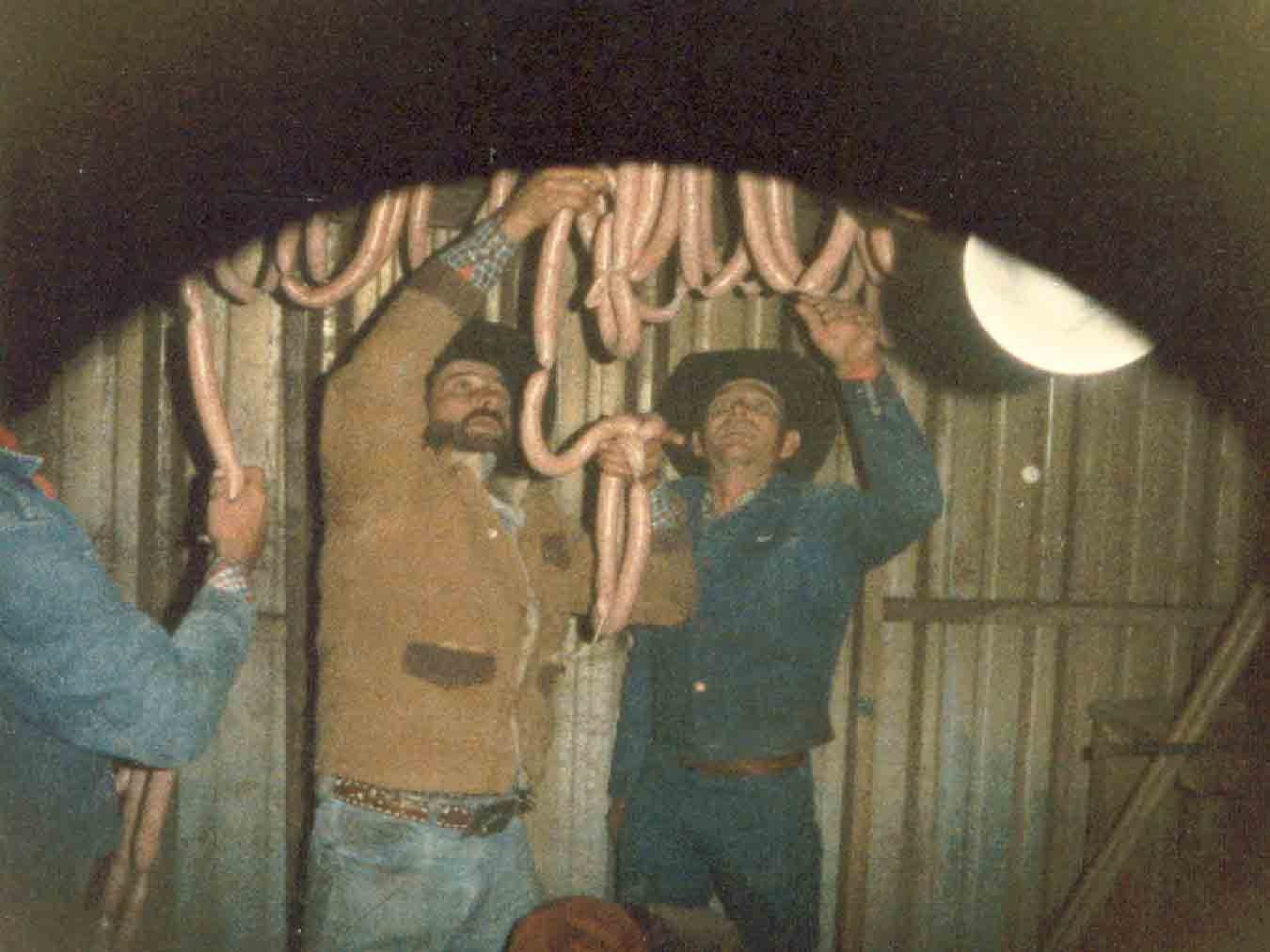
Hanging the sausage to smoke
Hanging the sausage to smokeWe recently visited Garland and his wife and immediately on our arrival, he took me to the back of his house to show me his new smokehouse. When he opened the door, I thought I had died and gone to heaven. The smell was so overwhelming that saliva began filling my mouth and memories of the old days began flooding my thoughts. I had not smelled the spicy magnificence of fresh, handmade pork sausage, which was curing under the lazy smoke of a native pecan wood fire, for many years. As I drank in the fragrance and looked inside, I saw hundreds of sausage hanging from nails driven into the rafters. After standing there for sometime feasting my nose, I realized the door was open and too much smoke was escaping, so I stepped out and closed the door. As I glanced around I saw the scraping platform with portions of hog hair still laying there; the scalding barrel and the scale-like bar where the animals were hung by their Achilles tendons to be gutted. In the conversation that followed, I discovered these sausages had come from wild Piney Wood Rooter Hogs which had been caught in the nearby river bottom. The animals had been brought in alive and grain fed for two months prior to butchering. Garland then guided me to an elevated pen in a back corner behind the smokehouse and to my surprise, pointed to a live Piney Wood Rooter in the pen. The hog was about two years old, had wild long hair growing in all directions along his back, a long nose with his upper lips just beginning to bulge with the tusks that were starting to grow. The hog watched us with menacing eyes, but had already learned that it did no good to charge, because the strong hog wire enclosing the pen was rough on his nose. Garland informed me the hog had been caught as a boar, but had been castrated. He said the musk associated with a boar hog would now be absent and makes the meat of the animal, when butchered, more palatable. Our entire conversation over dinner that evening dwelt with hog hunting and hog hunters. As I have already indicated, I was not completely ignorant of hog hunting. After all, I had grown up in the area. I remembered an old gentleman from Daisetta, who had sustained a large family and kept the wolf from the door for over fifty years, primarily by hunting these temperamental creatures. His name was Bowen Taylor – a relative of Garlands. Bowen, from all reports, was the absolute king of hog hunters in the lower Trinity Valley. Garland’s description of his last hog hunt is as follows: It was a cold Saturday morning this past December. I was up feeding my dogs at 4 AM. The reason for feeding so early was because the dogs should not be run on a full stomach. As it was turning light around 6AM, my brother, Jimbo, the Potez brothers and John Brett rode up to my house. Good thing I didn’t have any close neighbors, cause the sound hog dogs make when they know they are going on a hunt is a little short of thunder. All together, with my two, we had nine dogs. I realized that was too many dogs, but the boys had some young dogs they wanted to work and since we were all holding down full time jobs, there might not be too many chances.
Jimmy Taylor unleashing the dogs

Jimmy Taylor unleashing the dogs
A light mist began falling as we entered the bottom and our horses were laboring through knee-deep muck. The dogs were fanning the area to our front and it was a pleasure to see the young dogs imitating the old experienced ones. The boys were in a high ol’ mood. They were laughing and joking and listening to the music of those dogs. Although we were enjoying the comradely, our ears were always cocked for a tone change in the sound of the dogs. Once they hit a trail, the tone became eager and expectant and began moving away from you at an accelerated rate. Many times you had to do some tall riding through thorn thickets to keep the sound in range. Since we all wore cowhide leggings and had been bush popping since we could walk – we could handle the ride. The dogs were becoming too scattered and I had just lifted my hand carved cow horn to blow them in closer when Jimbo’s dog, Ol’ Blue, changed his tone. As we set spurs to our mounts, we could hear the other dogs converging on ol’ Blue’s sound. The hog had started running north or up-river and we realized we had to get there by the time the hogs stopped running and the dogs bayed. With this many dogs, they would kill the prey if we were late getting there to beat them off. As we were storming through the thickets watching for low hanging limbs and armadillo holes, we heard the dogs bay. We were still too far away and increased our speed to try and save the poor hog the dogs had bayed.As I broke into a small clearing that was covered with palmettos, the first thing I saw was one of the young dogs being thrown some seven feet into the air. The screaming of the dogs, the grunting and snorting, but mostly the musk smell that suddenly penetrated my nostrils told me beyond doubt, the dogs had bayed one of the most dangerous things on the continent – an ol’ Piney Rooter boar hog. As the other riders came up and we moved in closer to the action, we could see two of the young dogs were already out of the fight and bleeding profusely. The older and more experienced dogs had more respect and knew better than to charge headlong into those four-inch ivories that were sharp as razors. The young dogs were paying a bitter price for their inexperience. The hog, which looked to be a ten-year-old, stood nearly three-foot at the shoulders and in the neighborhood of four hundred pounds, was going about his self-preservation in a business like manner. By this time all six of the young dogs had been cut and had learned the foolishness of getting in range of those flashing tusks. The hog had backed into the depression left by a large pin oak tree, where it had uprooted and gone over. He had his back up against the root base and was quite effective in teaching a lesson to those young dogs. I took my rope from the saddle and as the dogs kept his attention; I walked up the log from the opposite side of the protruding roots. I dropped a loop over the hog’s head and just let it lie until he stepped forward and put a foot inside the loop. I knew if I tightened the noose with just his head in it, he would jerk out. As the boar stepped into the loop, I jerked and as the hog fell on his side, the other boys jumped him. Holding his ears and legs so he couldn’t slash with his tusks, the boys got a hitch around his snout and quickly tied his feet together. The boys had slapped the excited dogs away with their hats and after just a few frantic minutes; the dangerous animal was ready to be hauled to the fattening pen. Of course coaxing one of our mounts to accept this smelly bundle on his back was another problem to overcome.

Garland bringing the bacon home
Our hunt as far as getting the rest of this pack was out of the question. We had to stop the bleeding on six young dogs and spend time tying each dog up – so we could stitch up his wounds.
Garland bringing the bacon ho
Readying a cut dog for stitches
As Garland came to the end of his story, I asked about stitching the dogs. He took out his wallet and showed me a small sewing kit. It contained a stainless steel half moon needle and a quantity of gut thread. He explained that no hog-hunter would take to the woods without his stitch kit and a bottle of Jack Daniel’s. He grinned and said, “Of course the whiskey is strictly for antiseptic purposes”. These boys skin the hogs (a process I had not seen before) I tried to continue the conversation, but Garland had gone into a trance-like state and seemed to be reliving the hunt through the telling. I suppose that state is what you call “Hawg Heaven”.


Comments
Post a Comment